For Businesses All Over America, Staying Open & Keeping Your Business Safe is of Vital Importance
As business owners, store managers, or supervisors, we are responsible for keeping our employees, colleagues, and customers as safe as possible. The onset of the Coronavirus has exponentially made this responsibility more challenging.
Keeping Our Business Safe
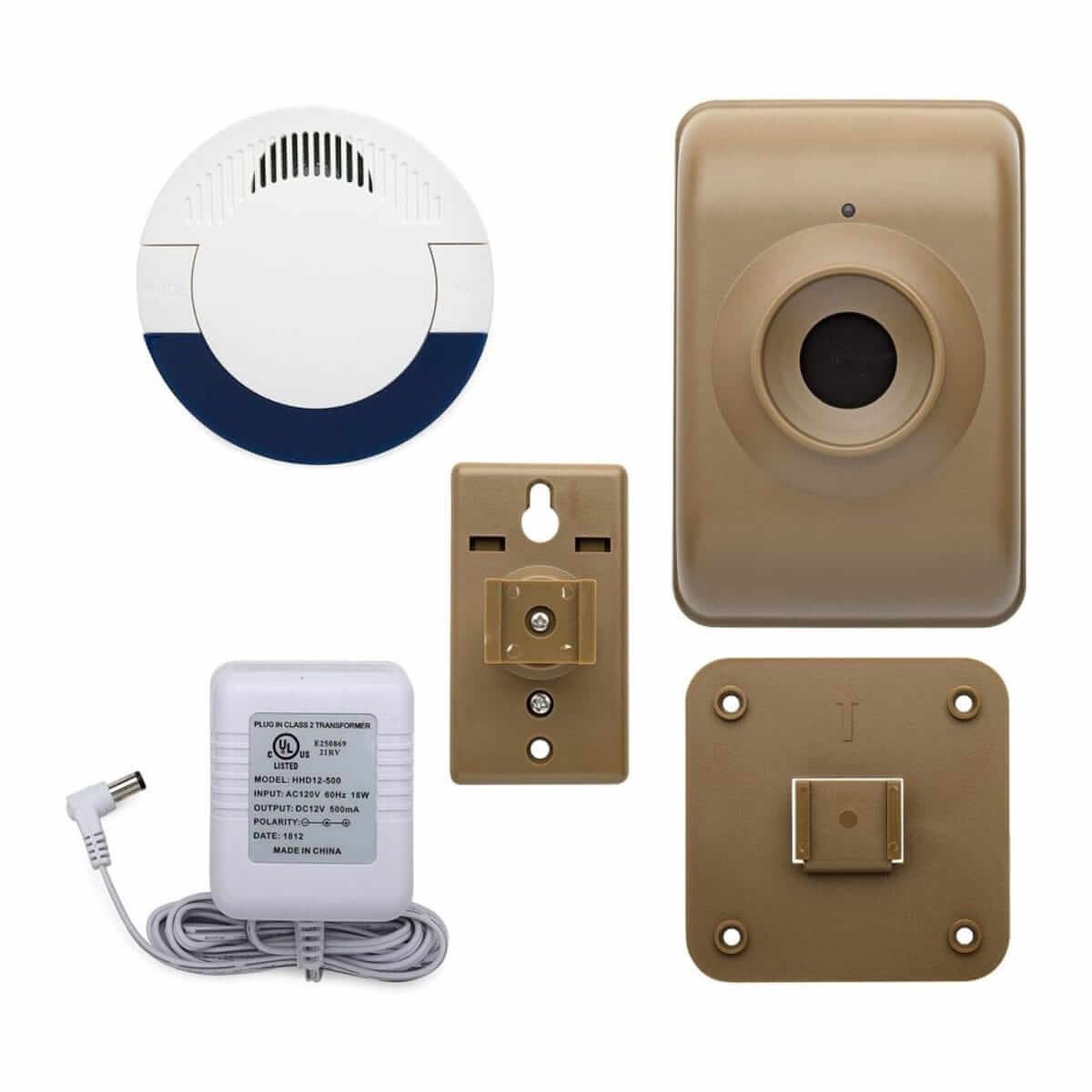
Our products, such as the ERA-UTDCR, WDK-ERA-STROBE, and others in the ERA or LRA series, are easy to set up and run and require zero maintenance. Most of all, they are reliable products that NOTIFY YOU when a visitor arrives.
Our Product Recommendations to Protect Your Employees and Customers:
We recommend two product lines to our customers, the ERA and LRA. Both sets are long-range wireless products that feature push buttons, motion sensors, & magnetic door contacts with receivers. Both product lines are expandable, meaning you can add multiple sensors and multiple receivers.
The significant difference between ERA and LRA product lines:
ERA has a wireless range of up to 4,000. Receivers are plug-in only.
LRA has a wireless range of up to 1,000 ft. Battery-operated and plugin receivers are available.
Both product lines offer various features with subtle differences. Both offer strobe lights built into the receiver or the ability to add accessories such as strobe lights, sirens, etc.
The ERA line of products by Safeguard Supply is our longest-range set of products specifically designed for large areas. The line-of-sight distance (wireless range) from the transmitter (push button, motion sensor, etc.) to the receiver (where sound is emitted) is 4,000 ft.
The receiver plugs into a standard wall outlet with up to 12 transmitters. Use as many receivers as you need. When a push button, for example, is pressed, all the receivers in the system will play the programmed melody.
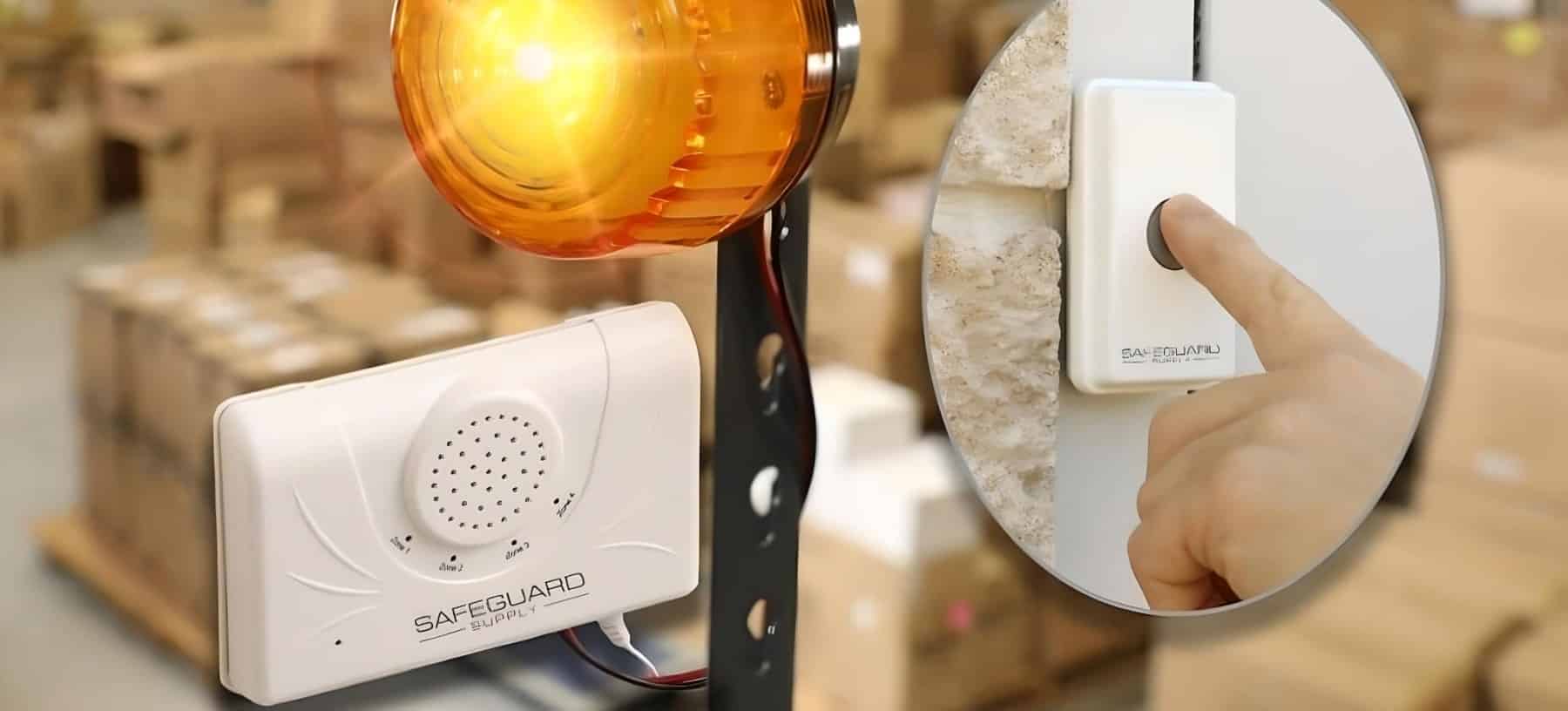
Receivers may be equipped with accessories such as a strobe light, strobe light + siren, siren, or fire alarm bell. Strobe lights, for example, are great for very loud areas and for areas where you need to turn the sound off but would like a visual notification. The siren accessory is extremely loud and can add an alarm sound when a button is pressed or a door is opened.
ERA – Features that Make ERA Products the Number 1 Choice for Business Door Chimes
Each receiver, ERA-DCRX, can pair with up to 12 different receivers, allowing you to cover all entrances into your facility.
Each transmitter (ERA-UTX or ERA-PIR) can pair with unlimited receivers, allowing you to add receivers throughout your facility.
Each ERA-DCRX Warehouse Doorbell receiver has four zones. Transmitters are grouped into zones, and a distinct melody (13 available) is assigned to each zone, allowing you to determine which transmitter triggered the receiver.
The volume control button turns the volume to four sound levels, in addition to mute and power off.
Plugs into a standard wall outlet.
Each zone features a 12V DC output. These outputs may power external devices such as a strobe light, strobe+siren, siren, etc. You can turn the receiver down and only see a visual indicator, or for loud areas, see a bright strobe and hear a siren alarm sound.
The duration of the 12V DC output may be set to 5 sec, 10 sec, 1 min, or 2 min.
Each receiver features a 1 x C-form relay for integration with external devices. For example, some magnetic door locks allow integration through Normally Open or Normally Closed connections. The receiver’s C-form relay can be integrated into that device.
Transmitters include the ERA-UTX (door contact or push button) and ERA-PIR motion-activated sensor.
LRA Long Range Alerts by Safeguard Supply
The LRA line of products offers a wireless range of up to 1,000 ft. from the transmitter to the receiver. Three different receivers are available: the LRA-DCRX, a battery-operated receiver with an add-on plug, a portable receiver, and a plugin receiver.
Similar to the ERA series of products, a variety of transmitters/sensors are available, such as a push button, motion sensor, magnetic door contact, and driveway alarm sensor.
The LRA-DCRX battery-powered receiver and LRA-DCRXS plugin receiver both have three modes of operation: strobe only, strobe & sound, and sound only. Additionally, the LRA-VPRX is a portable receiver with vibration mode.
LRA Features and Benefits as Door Alerts and Door Chimes:
LRA-DCRX and LRA-DCRXS Feature built-in strobe lights (turn it on or off) and sound options.
Battery-operated receiver (LRA-DCRX) has an optional add-on plug, and LRA-DCRXS plugs into a standard wall outlet.
Multiple transmitter types – push buttons, door contacts, motion sensor, and driveway alarm available.
There is no limit to the number of receivers you can use. You can mix and match different receivers with different transmitters; they are all compatible.
LRA-DCRX works with up to 4 different transmitters – LRA-DCRXS works with two transmitters.
The LRA-DCRX receiver features volume control up to 90 dBA and a variety of sound options.
Door Chimes, Doorbells, Entrance Alert, & Panic Notification Products for Employee & Customer Safety, Please Note:
For businesses, warehouses, manufacturing facilities, hospitals, and other facilities that need products to notify you when a visitor arrives, or other entrance alert products, please visit our business door chime products page.
We recommend the ERA products by Safeguard Supply for their long-range capability, reliability, ability to add multiple sensors and receivers, and ability to add accessories such as strobe lights, sirens, and more.
If you need a new doorbell for your home or business, the easiest path for you would be to choose wireless. However, the majority of homes do have existing wiring for a doorbell, even if it no longer works. Often, you can use the existing wiring and add a new doorbell button and indoor speaker.
If your home is already wired to include a doorbell or is just being built, you’re in a true either/or situation. You can just make your choice about wireless vs. hardwired doorbells based on whether you like the features and flexibility of a wireless doorbell. Or you may decide that you prefer the large selection of decorative doorbell styles available for hard-wired doorbells, allowing you to complement your home’s décor perfectly.
Wireless doorbells have more features, but fewer designer options. Many wireless doorbells offer functional plain white or beige components, with a few more elaborate designer styles. If you choose a hard-wired doorbell, however, you will find lots more designer choices. Looks range from retro brushed steel to ornate, antique metallic scroll designs to sleek, polished wood doorbell covers.
What’s Good About Wireless Doorbells?
Affordable and versatile, battery-operated wireless doorbells can be placed almost anywhere and take just minutes to install. Radio waves connect the transmitter (the outdoor button or buttons) to the receiver (the bell or speaker inside the house). This renders physical electrical wiring unnecessary. Here are some of the advantages of wireless doorbell technology:
Versatility: It’s simple to move the location of a wireless doorbell to better fit your home’s layout.
No changes to the house are required: Some people would rather not drill holes in their walls (although they are very small holes) and run wiring. No holes are needed for a wireless doorbell.
Simple installation: The transmitter button can simply be attached to the wall with the adhesive strip on the back of the unit. The indoor receiver may plug into the wall or run on batteries.
Range is sufficient for most homes: The range of wireless doorbells has been improved to the point that the radio signals, transmitted from the front porch doorbell button to the indoor receiver can be heard throughout the entire house. Signal ranges vary from 150 feet up to 1000 feet.
Extenders are available: If you have a large home, extenders (additional receivers) are available to relay the doorbell signal for a larger property. There are also portable receivers that you can take with you. These are handy if you’re working in the backyard or garage.
Multiple channel operation: With this feature, your wireless doorbell avoids interference from a neighbor’s doorbell. If your bell is sounding when the neighbors have a visitor, simply change the frequency of your doorbell to another channel.
Battery-powered with long-life batteries: The transmitter buttons are typically powered by long-life lithium batteries, which are usually supplied with the transmitter. The receivers inside the home may plug right into a wall outlet – or may be run by batteries. (These batteries are not usually supplied.) Most wireless doorbells will operate for up to 2 years before battery replacement is needed. Chime variety: If you’d like to have the option to change the doorbell tone, tune, or melody, many wireless doorbells offer several choices – some even offer 50-plus. This multi-tone capability is also helpful if you want to use multiple doorbell buttons, for instance, front door, back door, side door, etc. You can assign a different tune to each door. Advanced features: Some wireless doorbells offer security and convenience options like intercoms, motion detectors, and/or window sensors. Some models offer a visual signal – a flashing light – along with (or instead of) the audible doorbell. These audible and flashing light doorbells work well for the hearing impaired. The visual signal is also handy for a business where the noise level would prevent you from hearing a doorbell.
Wired Doorbell Advantages
More decorative options: Many wireless doorbells offer purely functional plain white or beige components and also offer some designs that are more ornate to match your décor. If you choose a hard-wired doorbell, you will find more designer choices. Looks range from retro brushed steel to ornate, antique metallic scroll designs to sleek wood doorbell covers and more.
Pricing is about the same: As wireless models.
Fairly easy to install: Since your home may have most of the wiring already.
Can accommodate a lighted push-button: If your doorbell is completely hard-wired with no batteries to run down, a lighted button will usually work. With a wireless doorbell or any battery-operated doorbell, a lighted button would burn through the batteries too quickly to be practical.
No concerns about interference or range: The hardwired system can have a range as long as you have wires to support it. There are no signals transmitted over the air, so no interference. (Although wireless systems have options to eliminate these issues.)
More traditional chimes: For those who prefer the classic doorbell chime tones with rich symphonic sound over whimsical sound options – and those who would never want to change the sounds anyway, hard-wired doorbells work great. You do generally get a unique front door and back door chime sound with a wired doorbell, that’s enough for many homeowners.
How is a Hard-Wired Doorbell Installed?
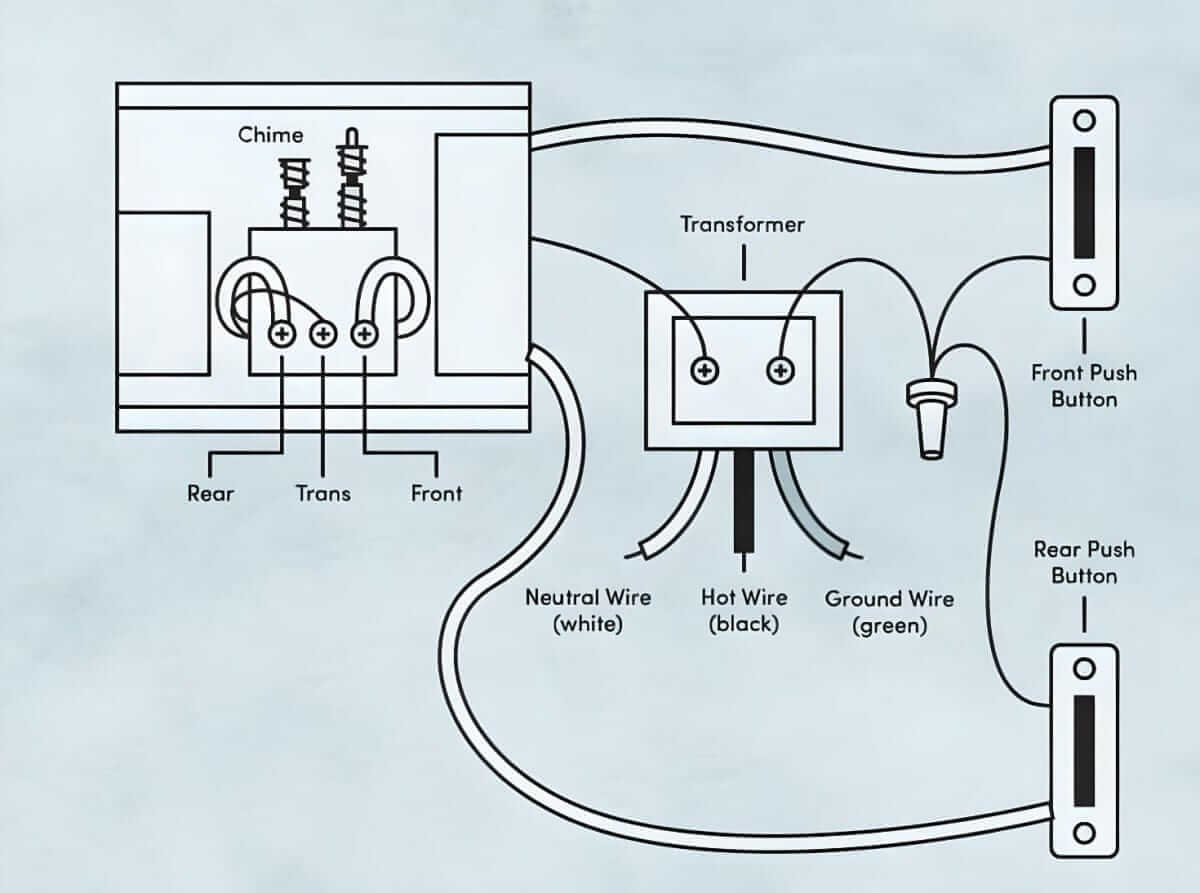
If you decide you’d like a wired doorbell, electrical wiring must be fed through or run along your walls. Holes must be drilled. Doorbell buttons must be mounted outdoors. Indoors, a speaker or speakers must be mounted and wired to run between them and the button outdoors. (Much of this doorbell wiring may already exist in your home.)
The doorbell wiring must then be wired into a transformer near your circuit breaker box to make sure the right amount of voltage goes to the doorbell. A transformer may sound like a big deal, but they’re often in the $20 range and available right here at 1800Doorbell. On our website, you can purchase your favorite doorbell and any add-ons or upgrades for security or motion sensing. Once your hard-wired doorbell is installed, it can’t be moved or extended without running more wire and drilling more holes.
Now for the Difficult Choices: Doorbell Styles, Security Features, and Options
Once you decide which you prefer in the wireless vs. wired doorbell dilemma, now you have some more difficult decisions to make and options to choose from. When choosing a wireless doorbell, you can select models with a variety of safety and convenience features. You can purchase wireless doorbells that offer many different sound options. You can use a different sound for each door and change the doorbell tunes (or sound effects) to celebrate holidays or just for fun. If you’re going with a hard-wired doorbell, you have a large selection of styles to choose from to fit any décor: from traditional to contemporary to vintage and more. You might choose a hard-wired brushed-nickel contemporary doorbell, a doorbell with a handcrafted wood design, or another style.
Get Professional Advice and Support from secure.1800doorbell.com
When you need a wireless or hard-wired doorbell, look no further than 1800Doorbell.com. Please browse through our huge selection of doorbells and accessories. Order online nationwide! If you have questions, just call our toll-free number: 1-800-DOORBELL (366-7235). One of our trained doorbell experts can help you with your decision or answer any questions about products, features, and installation. Or, send us an email and we can help you with your choices that way too!
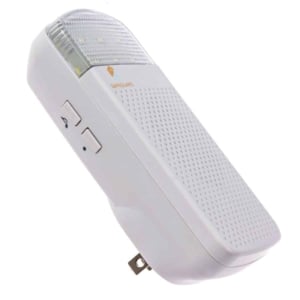
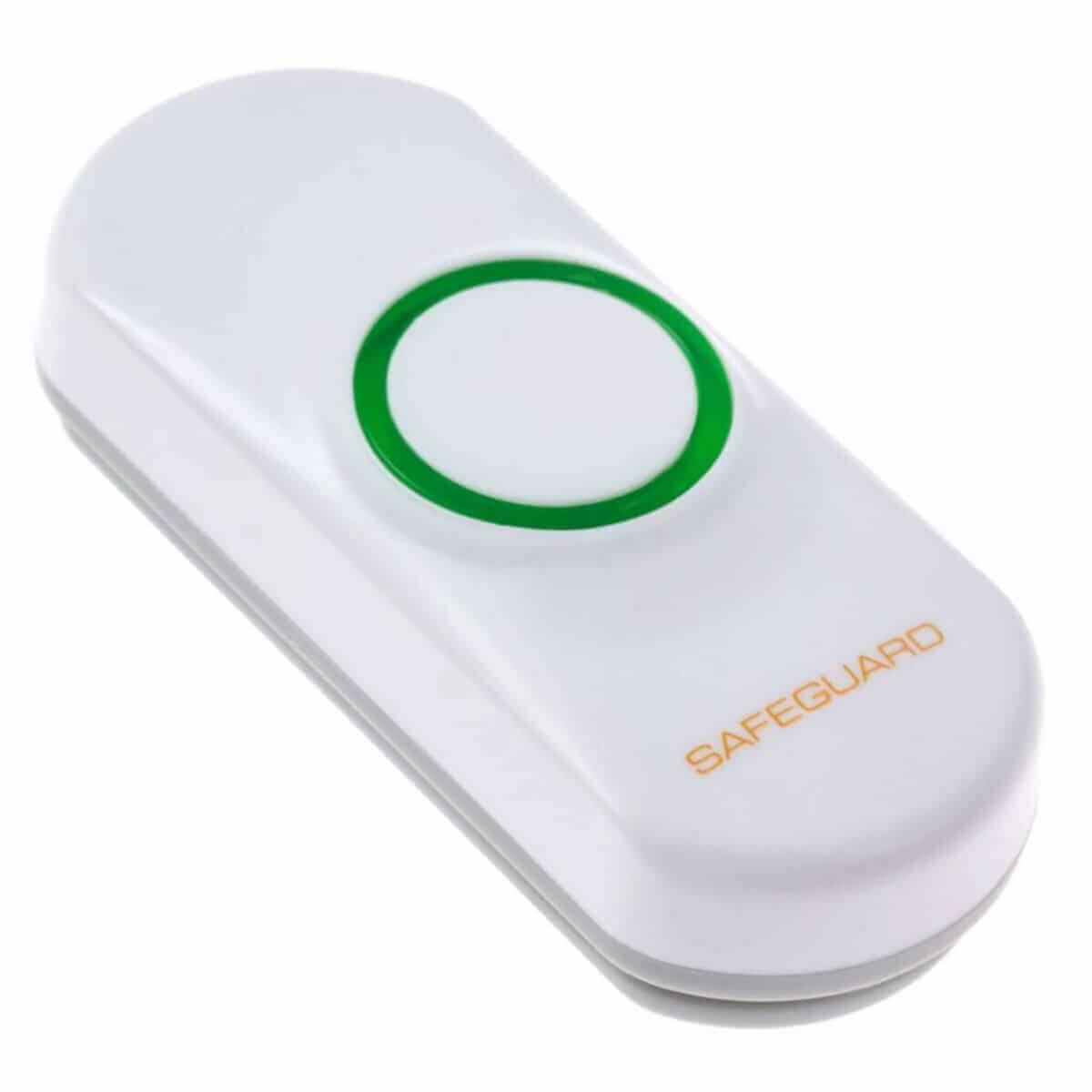
The LRA-D1000S is a wireless door chime kit by Safeguard Supply that features 1 x wireless push button (transmitter) and 1 x plugin door chime receiver. This kit ships with the push button programmed to the receiver, which plays the basic “ding-dong” melody when triggered by the push button.
The receiver featured in this kit is the LRA-DCRXS and works with up to 2 x transmitters. These transmitters can be push buttons, motion sensors, door contacts, or a door chime extender. Most users choose a distinct melody for each transmitter paired with the receiver to distinguish which transmitter triggered the receiver.
For example, you may have a wireless push button outside the front door. When a visitor pushes that button, this receiver (and others you may have added) will play the basic “ding-dong” sound. You may have a back patio door push button programmed with a different melody. You can determine which door the visitor is at by hearing the melody played.
Step by Step on Changing the Melody on the LRA-DCRXS Plugin in Receiver
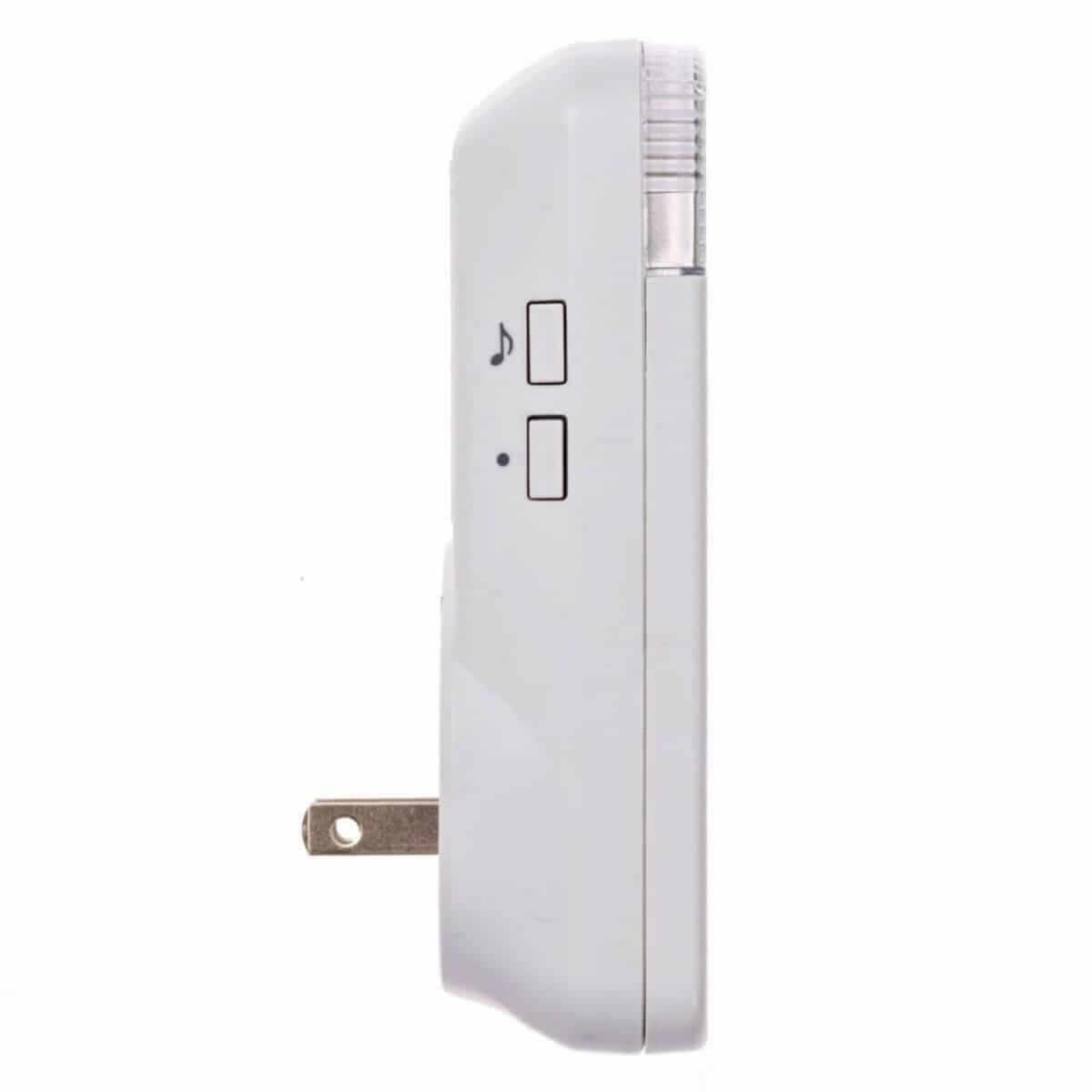
Press and hold the mode button (a solid black dot on the side of the receiver) for approximately three seconds.
Release the button when the unit enters programming mode. A red LED will appear in the strobe light lens to indicate that the unit is in programming mode.
Press the musical note to scroll through the available sounds.
Once you hear the sound you want, press the push button on the transmitter already paired to that zone.
Exit programming mode by pressing the solid black dot until the red light disappears.
Watch the video below.
The video below demonstrates changing the melody on the LRA-DCRXS.
Audio Transcript
Good afternoon, my name is Michael with Safeguard Supply and in this video I’m going to demonstrate how to change the melody played by the LRA DC RXS receiver. When you purchase the LRA D 1000S kit, this push button comes pre programmed to the receiver and it’s programmed to play the basic ding dong melody sound.
If you want to change that sound, Follow these steps. The first thing you’re going to do is notice that there’s two buttons on the side of the receiver. The first is a solid dot and the second one is a musical note. We’re going to hold down this solid dot for about three seconds until you notice a red dot, a red flashing LED or a red LED will appear within this window.
I’m going to hold down this button for about three seconds. And we see that red LED appearing in the window. And what that does is notifies you that we are in program mode. Next, I’m going to toggle through the available melodies by pushing this musical note button until I get to the one that I want.
And then I’m going to stop pressing the button. So here we go.
So that’s just a basic door knock sound, but that just happens to be the melody that I want. So I’m going to take my push button again and I’m going to push the push button. And when you hear those two quick, short tones, that lets you know that it has accepted the programming. And notice that that red light is still on.
So the next step is just to push this solid dot button again. The red light disappears. That notifies you that we have successfully exited programming mode. And now the system is ready to use. So I’m going to take the push button just to test this out. And the expectation is that it plays this basic knock knock sound.
So I hope this helps. Please call us at 800 366 7235 or email us at info at 1 800 doorbell. com if you have any questions. Thank you.
With over 100 different entrance and exit alert products available on secure.1800doorbell.com, it may seem a little overwhelming when you are trying to decide on the best entrance alert chime for your home, office, warehouse, or retail location.
So What Are Entrance Alerts Anyway?
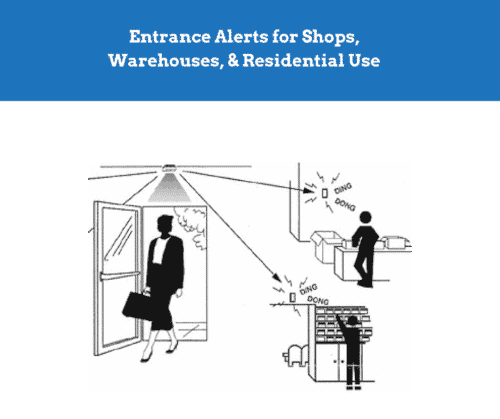
Entrance alerts may be known by a variety of names like entry alarms, entry chimes, and even exit alerts. Loosely speaking, an entrance alarm is anything that alerts you when someone, or something, enters or exits through a monitored zone. A quick example of one that’s been around for hundreds of years is the shop keepers bell that hangs over a shop’s entrance door. When someone opens the door, a gentle bell sound is generated.
You could think that a entry doorbell might be an entry alarm, but a doorbell works when a visitor pushes the push button, while an entry alarm happens without the user having to push anything.
Common Uses of Entry Alarms & How to Choose the Right Entrance Alert Chime
Customer Service Benefits
Most convenience stores, for example, have some sort of product that alerts the clerk when someone enters their store. A good alert allows them to work in the store and not have to sit and watch the door. When someone enters, they can stop what they are doing and serve the customers.
We have a large number of convenience store owners who have an entrance alert chime on the front of their store with a speaker in the beer cooler. This allows them to stock and organize the cooler and still receive a notification when someone comes in.
We also have several large retailers who use our products in a mall. Since there’s no real door, many of these shops use passive infrared beams that span the entire entrance. When a new customer enters the store, a gentle chime sound signals the clerks of the new entry.
At our company, we need to be notified when a delivery truck approaches the backloading door. Before installing a notification system, drivers would pull up, beat on the back door, then immediately leave when no one came to the loading dock door. Now, we use an ERA-PRDCR by Safeguard Supply to let us know when a delivery truck approaches.
Security Reason to Use Alerts
The examples above tend to gravitate toward using these products for customer service. Most would agree, that there’s a reason more important than customer service—security. With the rise of workplace violence and terrorism, ensuring you and your employees are safe is of utmost importance.
The other day, I took my truck to a service station for an oil change. It was around lunchtime and there was a clerk at the front desk and two mechanics in the shop servicing cars. The thing that struck me was the fact there were four bay doors open and no one watching them. A simple passive infrared sensor over each of the bay doors would alert the mechanics when someone was entering the work area.
You might also have areas you don’t want unauthorized visitors entering. A simple store entrance alert chime would send an instant alert to store clerks if a customer walks into unauthorized areas.
Safety Applications of Entrance Chimes
Most states require some sort of alarming device for doors that lead out to a pool. Although requirements may be different in your state, many of the products on 1800doorbell fit these requirements.
An easy-to-install door/window contact sensor will alert parents or babysitters when a child opens an exterior door that leads to a pool or spa. You can also install these same sensors (depending on the model) on fence gates to alert you when a child opens a gate door. Some of the products have gentle chime sounds while others have blaring alarm sounds that are ear piercing. Additionally, it is possible to easily change the sound of an entrance alert. Whichever you choose, anything you can use to increase your child’s safety is recommended.
As our parents and other loved ones age, diseases like dementia and Alzheimer’s become real issues we need to deal with. Do-it-yourself alerting products are cost-effective ways for us to know where our loved ones are. Whether it’s a nursing station or a chime receiver in our home, receiving a notification that a door or window has opened may be the difference between life and death.
Types of Entry Alarm Sensors
There are two basic types of sensors to think about:
Contact-based sensors
Motion-based sensors
Contact-based sensors work when a door or window is opened. These sensors usually consist of two pieces; a magnetic part and a metallic part. One piece is usually mounted on the door frame while the other piece is mounted on the door itself. When the door (or window) is opened and the two pieces separate, the sensor is activated. Depending on the specific model, this will trigger an alarm on the sensor itself or the sensor will transmit a wireless signal to a receiver.
These types of sensors work best on doors or windows that normally stay closed. If you have a hallway, open space, or door that typically stays open, we recommend a motion sensor.
Less prone to false alarms – only trigger when door or window is opened.
A smaller profile allows you to specify the monitored area.
Sensors are also transmitting a signal and a metal door or window frame may interfere.
Doesn’t work on doors or windows that typically stay open.
Motion-based sensors work when movement or a combination of heat and movement is detected. When a combination of these variations occurs, the sensor is triggered. Some models, like the ERA-PIR-SPK, will sound an alarm or chime sound at the sensor itself, while models like the ERA-UTDCR by Safeguard Supply will transmit a signal to a receiver.
Can be used on doors and windows that normally stay open.
Can be used for hallways and large, open areas.
Reliable in commercial applications and at long distances.
Occasional false alarms.
Entry Alert Kits or Stand Alone Models
Virtually all of the products we sell in this category are true do-it-yourself products. This means you do not have to hire a licensed contractor to install the products for you. Don’t let this ease of installation or low cost mislead you. These products are highly effective and do the job. We mentioned above that the sensor will trigger based on the contact separation or detected movement, but how is the alarm sounded? Some models are stand-alone units, meaning the alarm/speaker is co-located with the sensor itself. When movement is detected, the sensor itself will generate and emit a chime or alarm sound.
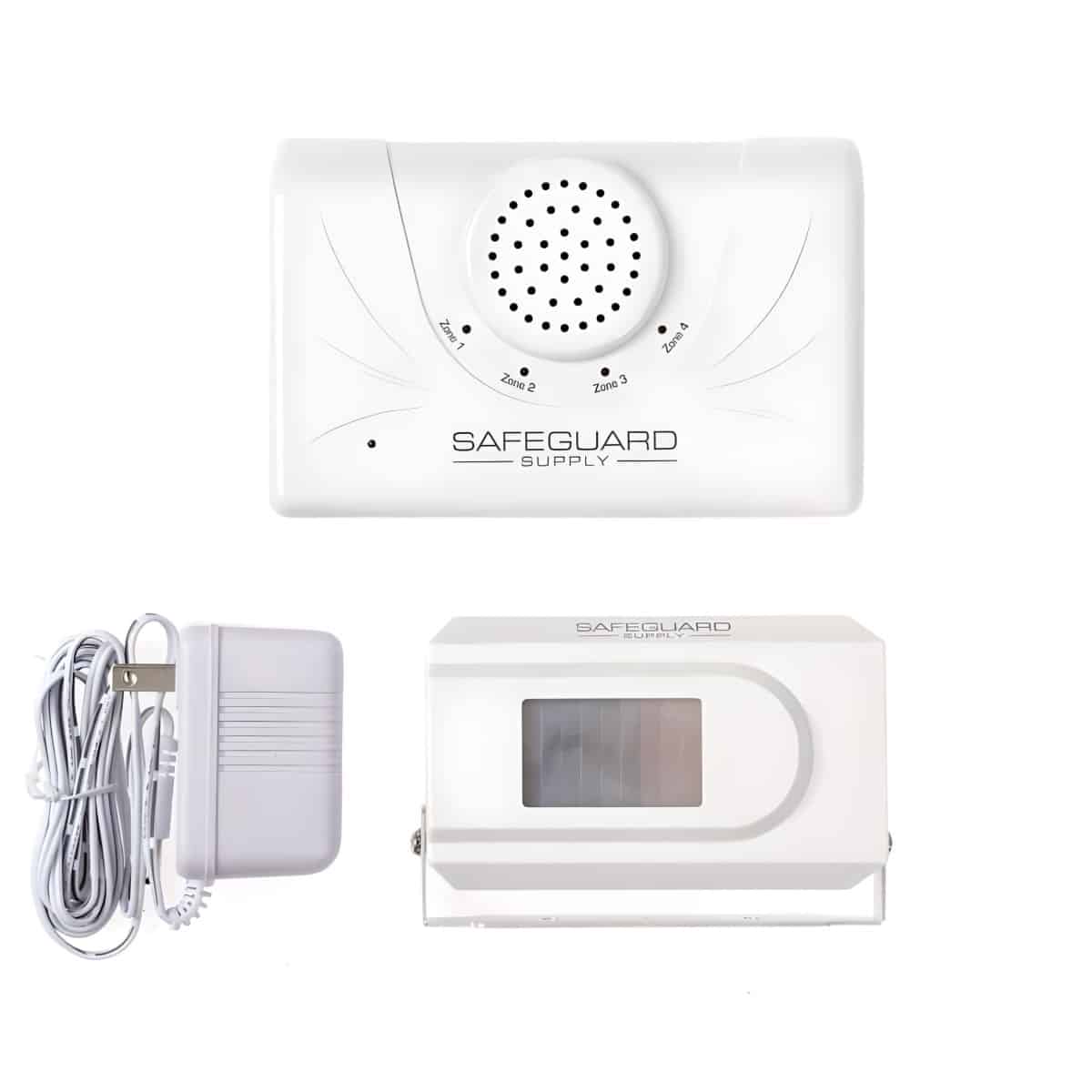
A great example of this is the ERA-PIR-SPK. This particular product uses the same PIR sensor as the ERA-PRDCR. Unlike the ERA-PRDCR, the actual chime sound emits from the actual sensor at the door. Most users would mount this small, lightweight sensor over a doorway and when movement is detected, it emits a ding-dong chime sound. The ERA-PRDCR uses a very similar type of sensor, however, unlike the ERA-PIR-SPK, sound is not generated from this unit. It does, however, send a wireless signal to a plug-in receiver, up to 4,000 ft. away. This allows users to be a distance away from the monitored zone and also receive a notification when triggered.
Most kits that feature a sensor/transmitter and a receiver are expandable, meaning you may add more transmitters/sensors and receivers. Some feature plug-in receivers while others have battery-operated receivers, but the concept is the same.
Users also need to consider distance. How far will users be from the actual sensors? If they will be at the sensor, or maybe up to a hundred feet away, a self-contained sensor/alarm may be perfect. However, if users are going to roam around a warehouse, or if an office isn’t very close to the monitored zone, a user may need to think about kits with a separate transmitter and receiver.
Some kits have a range of up to 150 ft., while others like the ERA-UTDCR have a range of up to 4,000 ft. The maximum range of these systems isn’t just about the total foot distance of range—other environmental factors will also play a role.
Most commercial buildings have concrete, steel, and other building materials residential buildings may not have. These factors will play a role in the transmission distance, so even if the range from the front door to your office is only 100 ft., (well within the range of the SS130, for example), the metal in the walls would cut down on the actual transmitted range. Therefore, we would recommend something with a range like the ERA-PRDCR, with a range of 4,000 ft.
Top Three Entry Alarms:
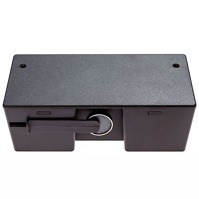
EZ CHIME: As one of the few worldwide distributors of this product, 1800Doorbell is proud to offer it to our customers. For smaller areas (1,000-1,500 sq.ft.), the EZCHIME has been a customer favorite for decades. It is purely mechanical, requires no batteries, and is installed directly on the door frame. This is a contact-based alert that emits a gentle tone. When a visitor enters the store or office, the small plunger strikes a metal plate inside the box and generates a tone. It’s not very loud, but it’s perfect for many retail locations. It retails for $26.98.
ERA-PRDCR: This is a long-range wireless entrance alert. As seen in the image above, this kit ships with one PIR-based sensor that transmits a wireless signal up to 1,000 ft. to the plug-in receiver. Users may expand this product by adding sensors and receivers based on their needs. This is our best-selling product and is recommended for most commercial applications due to its reliability and transmission range. The retail cost for this product is $119.98.
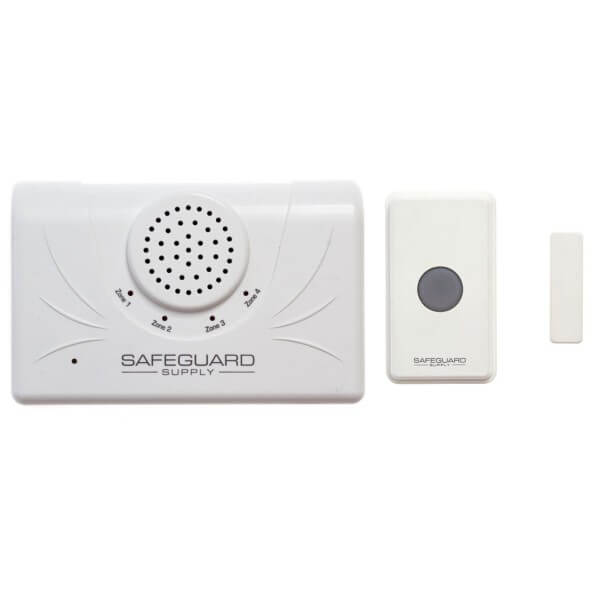
ERA-UTDCR: This is a contact-based, wireless entry alarm. With a range of up to 5,000+ ft., this product works great in warehouses and larger commercial applications. The sensor in this kit is a universal transmitter that may be used as a door/window contact or as a wireless push button. Similar to the DA50L-A, users may expand this product by adding more receivers and transmitters. This product retails for $89.98
This video demonstrates the basic programming of 2 LRA push buttons to the LRA-DCRXS plug-in receiver.
Please note, when ordered as a kit, the LRA-D1000S, the included push-button is programmed to the receiver from our warehouse. Follow this video to program a second push button.
This unit does not require wiring. Just plug the receiver into a convenient wall outlet, mount the push button, and you are ready to go. The WC180 has a bright flashing strobe light. Three sound options are available: ding, ding-dong, and a four-note Westminster chime. You can use different chime sounds for the front, back, and side doors.
Strobe Light Wireless Doorbell Product Video Demonstration
There are thousands of privacy codes, so you’ll never have to worry about interference or other push buttons triggering your receiver. In addition, you can add up to 58 different sensors, whether additional push buttons, such as the SS111 wireless push buttons, or even magnetic door contacts, such as the SS131, and assign a unique sound to each of them. There is no limit to the number of plugin receivers, the SS155 you can add throughout your home. No matter where you are in your home, you can see and hear when someone is at your door!
The WC180-SS ranges up to 600 feet, depending on the construction of your home or business. Before mounting, hold the push button where you want to install it and test the operation. Please note that if you are mounting the push button to a metallic or concrete surface, use a one-eighth-inch to one-quarter-inch wood spacer between the frame and the button. Add-on wireless buttons are available for additional doors. That’s part number SS111.
Video Transcript (Click Button to Watch Video)
Are you tired of missing deliveries or visitors because you couldn’t hear the doorbell? Do you have a noisy environment or someone in your household with hearing difficulties like I do? Then this wireless doorbell kit is for you. This is the model WC 180SS. It’s from Safeguard Supply and it’s the perfect solution for missed opportunities.
It comes with a bright flashing strobe light that lights up the room and believe it or not, it has 58 chimes and melodies to choose from. You’ll never miss a visitor or a delivery again. So let’s take a closer look. Introducing the WC 180SS wireless doorbell kit. It’s designed for clear and reliable notifications.
Here’s what makes it stand out. This LED strobe light is so bright it lights up the room so you’ll never miss a visitor. I hope you never miss a visitor or a delivery again. This 15 times per ring and it’s perfect for noisy environments or the hearing impaired. It has 58 chimes and melodies. And if you notice, There’s no wires, which means no hassle.
You simply plug in the receiver to any outlet and mount the push button next to the door outside. You can use anchor screws or the adhesive tape that it comes with. The wireless range extends up to 600 feet, and this is going to ensure that you can hear the chime and see the flashing from across your home or your business.
You can purchase more pushbuttons to cover more entrances and assign different chimes to each of them so that you know where the visitor or your delivery is. You can also purchase multiple receivers for larger properties so that every area is covered. There are thousands of privacy codes to prevent interference with other wireless systems used in the privacy settings.
So let’s set it up. Setting up the WC 180SS is a breeze. All you have to do is plug in the receiver to a wah outlet. preferably where you can see the light and hear the chime. Choose a chime or melody by pressing the music change button on the receiver. Now if it’s flashing, you may need to turn up the volume by pressing the volume button.
As you can see, you can control the volume to be very loud or very soft, or not at all. Okay, so now let’s choose a chime melody by pressing the music change button on the receiver and cycle through the chimes to choose one.
Once you hear the sound that you want, then you’re done. Next, we’re going to put the receiver in pairing mode by pressing and holding the volume control button for five seconds.
You’ll hear a short ding dong and LED strobe will start flashing. This means that the receiver is in program mode. When you’re ready to sync, remove the plastic tab from the push button to activate the battery, and then press the center of the button to sync it together.
You will see that the doorbell receiver will flash and play the selected melody that you chose. Now let’s test it out. Find a spot where you want to mount it, and in this case it will be where the old push button was, and for demonstration’s sake, I will use the adhesive tape.
The great thing about the WC 180SS is that it’s customizable, like the volume control, or the 58 chimes and melodies, and if you have a low battery, it has a low battery indicator indicator. That when you push the button, it starts flashing that way. You’ll never be caught off guard, but these batteries are built to last.
And lastly, you can expand your system to multiple entrances because it works with other SS series of transmitters and sensors by safeguard supply. So there you go. You’ll never miss another visitor or delivery at your door again. So get yourself the WC 180 SS wireless chime and strobe light today. And enjoy the peace of mind knowing that you’ll always be alerted when visitors are at your door.
Order now from Safeguard Supply and experience the difference.
Entrance Alerts, Exit Alarms, and Driveway Alert Receiver Sounds
On this page, you will find a collection of sounds and/or melodies played by the different driveway alarms, entry alerts, and exit devices we carry on secure.1800doorbell.com. We are continuing to build this list so if you want to hear a particular sound and it isn’t here, please check back as we are adding more sounds all the time.
If you have visited a similar page on our website, Door Chime Receiver Sounds, you might have noticed that many of the sounds found on that page are also on this page. That’s because the same receiver (where the sound comes out) might be the same receiver in a door chime kit and an entrance alert kit. For example, the LRA-D1000 is a wireless door chime kit, while the LRA-C1000 is an entrance alert kit. Both kits feature the same receiver, the LRA-DCRX.
What are Driveway Alarms, Entrance Alerts, and Exit Alarms anyway?
Before we get into the different sounds the receivers play, it’s important to understand what an entrance alert, driveway alarm, and exit alarm are. Let me start by saying that in most cases the same product or kit may be used as an entry alert or exit alarm, it just depends on how you want to use them. Entrance (entry) Alert (Alarm): These types of devices alert you when someone enters or passes through a monitor zone. For example, you have a showroom and want to receive an instant alert when someone enters the showroom. You might be busy in the office, but as soon as the door opens, an alert is triggered, alerting you that someone has opened the front door.
Another example may be the sensor on the front door of your gas station/convenience store. You could be stocking the cooler and need to know when a new customer enters the store. There are a variety of different sensors to choose from and the decision comes down to what the entrance is like that you would like to monitor.
Driveway Alarms: The idea is similar to that of an entrance alert, but in this case, you want to be alerted when a car enters your driveway or passes through a monitored zone. For driveway alarms, the sensor/transmitter needs to be outdoor rated and is typically mounted at or near the driveway or other outdoor entrances. When a car passes through a monitored zone, the sensor triggers and transmits a wireless signal to the receiver, thus alerting you that an automobile has entered your driveway.
Exit Alarms: The opposite of entrance alerts, whereas you want an alert when someone exits an area. A good example of this might be an emergency exit lock on a door. If that door is opened, you want to know because it was either a) an unauthorized exit, or b) an emergency. It is easy to imagine how the same products can serve dual roles. The same entrance alert may tell you when someone enters your store, but also alert you when someone leaves.
LRA Series of Long Range Entrance Alerts and Driveway Alarm
There are currently two different receiver features in the LRA series of products. The LRA-DCRX is a battery-operated (plugin is available) desktop or wall-hanging receiver. The LRA-VPRX is a portable receiver. Each of these receivers has four different zones, allowing you to pair a transmitter (push button, motion sensor, etc.) to each zone and each zone will have a unique sound associated with that zone. Below are three kits in the LRA series of products, along with the receivers that play these sounds. The fact that all the products in the LRA series are compatible with one another means you can have multiple receivers, as well as multiple transmitters/sensors.
NFPA: People who are hard of hearing may benefit from specialized alert devices. To alert people who are hard of hearing of a possible fire when they are awake, there are strobe lights that flash when the smoke alarm sounds. When people who are hard of hearing are asleep, a loud, mixed, low-pitched sound alert device should be used to wake them. They may find a pillow or bed shaker that is also helpful.
Home fire sprinklers should be considered by anyone who may need more time to escape a fire.
Does the NFPA recommend the use of medical/emergency alerts for seniors and those who are hard of hearing when a disaster such as a fire occurs?
NFPA: Each needs to plan around their abilities in case a fire occurs. A medical alert system can be a useful and reassuring tool for both the older adult and for family members who cannot be with the older adult’s loved one.
The NFPA has hundreds of helpful codes and standards built to minimize fire risk in buildings. Are there any specific codes/standards the NFPA has that pertain specifically to buildings that contain people who are hard of hearing?
NFPA: Yes, three. NFPA 101® Life Safety Code®, Chapter 9, specifically section 9.6 deals with Fire detection, Alarm, and Communications Systems and specific requirements so that people who are deaf or hard of hearing can access emergency notifications.
In addition, NFPA 5000® Building Construction and Safety Code® has extensive requirements in Chapter 12, Accessibility which combines the requirements of ANSI/ICC A117.1 Accessible and Usable Buildings and Facilities, 2010 DOJ ADA Standards, and the HUD Fair Housing Guidelines and covers all disabilities not just those who are Deaf or Hard of Hearing.
Do you have any resources you would recommend or point people towards that specifically focus on fire protection and safety for those who are hard of hearing?
NFPA: NFPA offers a variety of resources for people who are hard of hearing. We offer safety tips sheets on many fire safety topics and in many languages, including the “Smoke Alarms for People Who Are Deaf or Hard of Hearing” and the “Fire Safety for People with Disabilities” tip sheet. Many of our video resources including the Dan Doofus fire safety videos are available in open captions for those who have a hard time hearing the content.
Is there any other helpful information you’d like to share on fire safety for seniors, those hard of hearing, or home fire safety in general?
NFPA: All individual needs to get involved in their home safety. Many fire risks can be reduced with small behavior changes. The NFPA Remembering When the program is a fire and fall prevention program targeted toward older adults. The free program is available online at www.nfpa.org/rememberingwhen. The program is based on 8 fire and 8 fall prevention messages to help older adults make small changes that have a big impact on their home safety status. Messages around smoking, cooking, and the use of space heaters are examples of behaviors addressed in the program.
Knowing that fire safety at home is extremely important, are there any other general home security guidelines or tips that you promote at the NFPA?
NFPA: We offer safety information on a wide range of fire prevention topics ranging from everyday prevention topics such as safe cooking, smoking, and home heating to less common ones such as fire safety related to hoverboards, and 9-volt batteries, and CFL lightbulbs. All the safety information can be found online at www.nfpa.org/safety-information.
The Importance of Small Business and Office Security
Security should be your top priority if you’re a small business owner. After all, this is the business we’re talking about — you’ll want to do everything you can to protect your valuable inventory, files, and technology.
A quality security setup will also help you protect yourself and your employees during an emergency, no matter how extreme. It’s unfortunate, but you can never be too careful these days.
Investing in quality business security products for your office, store, or shop, whether advanced or basic, can make all the difference in deterring crime. Theft, robbery, and burglary are common crimes faced by small businesses and offices, yet a high-quality security system can help prevent or manage even more severe situations. Security products can even help you monitor your employees and ensure they follow their best behavior. As a small business owner, you don’t have to spend thousands of dollars on a product that works; some of the most straightforward small business security solutions are the most effective.
As security system experts, we’re proud to supply a wide selection of office security products to keep you and your employees safe and protect your business. We’ve rounded up a list of our favorite security products designed to deter crime and help give you peace of mind. Buy a standalone product to help enhance security, or purchase multiple solutions to create a complete system to protect your business best.
Our Top Office and Small Business Security Products
Emergency Exit Alarms – Emergency exits are just that: doors that should only be accessed in an emergency. However, back doors and side exits can also serve as prime entry points for burglars and intruders. A reliable alarm system, like the Alarm Lock Paddle Bar Emergency Exit Alarm, will discourage employees and visitors from using your emergency exits and alert you should an intruder come through a restricted area. This product, in particular, will sound an extra-loud alarm (roughly 95 dB) when triggered, so you won’t miss it when someone uses an unauthorized exit. Install it on a door that will serve as a safe exit during an emergency.
Door Alarm Systems – If you’re a store or shop owner, it can be challenging to monitor who is coming and going from your shop, especially if you’re having a busy day or need to spend some time in your stockroom doing inventory. Our selection of door alarm systems will emit an audible chime so you will always know whenever you have a new customer who needs attention. These products are also ideal for offices that don’t have an office secretary to handle incoming visitors.
Driveway Alarm Systems – For small businesses, especially those in rural areas, it may be necessary to go beyond installing a standard door alarm system. Driveway alarm systems add an extra level of security by allowing small business owners to monitor incoming visitors before they even reach your door effectively. For those needing a long-range system, the DCMA-4000 by Dakota Alerts is excellent for more significant properties and works with a 5,000-foot range. You won’t have to worry about false alarms triggered by falling leaves or light shadows, as this infrared system will only sound an alarm if heat is detected.
Keyless Door Locks and Electronic Deadbolts – Traditional office and building keys often get lost in daily hustle and bustle. Instead of issuing your employees a physical key, give each of them a building access code to punch in whenever they arrive at work for the day. Keyless door lock products have various easy-to-use features, including ergonomic keypads, simple programming, and easy retrofits for doors of all materials and lockets. Instead of changing the locks whenever an employee loses a key or leaves your company, you’ll have to change the passcode, saving you time and money. This small change can boost your office security to another level.
Long-Range Wireless Doorbell– These products have various powerful features, such as visual indicators when someone arrives at your door (great for loud environments) and multiple push buttons to distinguish between front and back entry. These products aren’t just great for monitoring doors—the LRA-D1000 by Safeguard Supply offers programmable window sensors to let you know immediately if someone opens a window in your office or shop. These long-range store doorbell systems also monitor package deliveries to your office or business.
Office and Business Security Solutions You Can Trust
Every business is different and will require varying levels of security. For smaller companies and offices, you may only need to set up emergency exit alarms, a simple door chime system, and perhaps a keyless door lock system. For a larger business with a warehouse doorbell, you may require a more comprehensive system with doorbells, multiple security cameras, and visual alerts. Whatever your needs may be, ensure you’re getting the right products for you. While we have a variety of security products to keep your office or building safe, there are plenty of other products out there that can be added to your inventory to strengthen your business’s safety and security:
High-quality safes can help you secure your valuables to prevent theft or damage from a fire or flood. FireKing offers a vast selection of commercial-grade safes to suit your business’s needs, from simple deposit slot safes to concealed floor safes for more advanced security.
Fire detection systems are vital for businesses of any kind. Johnson Controls carries a variety of fire alarm systems designed for large and small businesses with varying features and capabilities.
IT and cybersecurity are entirely different ways to protect your business. Finding a solution that efficiently backs up and guards your valuable data against hackers is crucial. Symantec and CSID offer comprehensive solutions designed specifically for small enterprises, but be sure to shop around and select a service provider that caters to your unique demands.
Investing in high-quality business and office security products will ensure your business, patrons, and employees stay as safe as possible. Be sure to browse our full selection of security products to discover a solution that works for you.
Range from transmitter to receiver is up to 5,000 ft.
The receiver does not have c-form relays or 12v dc output.
The receiver plays 12 different tunes or melodies.
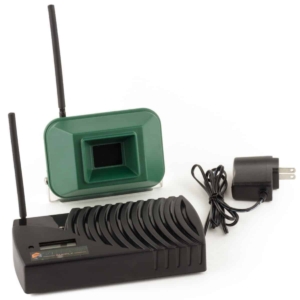
secure.1800doorbell.com offers one of the most popular and cost-effective long-range wireless motion detectors on the market, the DCMA-4000 Wireless Motion Alert Kit by Dakota Alert.
This kit includes one transmitter and one receiver. The DCMA-4000 Driveway Monitor Kit could be used by homeowners and business owners alike as a driveway alarm or entrance alert.
The wireless motion detector sensor transmitter will detect a person or vehicle passing by out to about 50 feet and then send the signal back to the receiver up to half a mile away depending on the local terrain. You can add additional sensor transmitters for the DCMA-4000 Kit. The DCMT-4000 wireless sensor transmitter can be used for other locations such as a second driveway.
The DCR-4000 is the receiver for the DCMA-4000 system. The receiver will play one of four different tunes that are selected at the transmitter so that different zones can be distinguished. The receiver has four C-relay outputs and one 12-volt DC output allowing you to tie in additional products to the receiver which includes a siren, a strobe light, or a bell.
You can also add additional receivers for the DCMA. The DCR-4000 receiver can be placed in other buildings or locations and will each sound at the same time.
For more information on the DCMA-4000 Wireless Motion Alert Kit and accessories, please visit us at secure.1800doorbell.com or give us a call at 1-800-366-7235.